

Manuel S. Enverga University Foundation MSEUF advanced its institutional carbon reduction and emissions reduction efforts through renewable energy generation, environmental performance monitoring, investment planning and sustainability policy review.
As part of its continuing sustainability initiatives, the University implemented measures intended to reduce its reliance on grid-supplied electricity and lower carbon dioxide emissions associated with campus operations.
These efforts reflected an ongoing approach to energy-related carbon management, connecting renewable energy implementation with measurable performance indicators, institutional decision-making and continuous improvement.
Institutional oversight of carbon reduction initiatives
MSEUF strengthened its sustainability initiatives in 2025 through the implementation and annual review of its Sustainability Policy, which identifies carbon reduction and emissions reduction as a principal area of institutional action.
The policy establishes targets, milestones and priority actions to guide sustainability implementation, monitor accomplishments and identify improvements for succeeding years.
The University's Technical Working Group (TWG), composed of qualified professionals and engineers, provides technical guidance on sustainability-related infrastructure initiatives.
Through this institutional framework, MSEUF supported the implementation of carbon reduction measures and the assessment of progress toward its sustainability objectives.
In 2025, the University's carbon reduction initiatives centered on renewable electricity generation, monitoring of environmental performance and planning for the expansion of solar photovoltaic infrastructure.
 |
Implementing carbon reduction through renewable electricity generation
In 2025, MSEUF continued implementing its carbon reduction initiatives through the operation of a 99.37-kilowatt-peak (kWp) grid-tied solar photovoltaic (PV) system at the Commerce, Engineering and Technology (CET) Building.
The system generated renewable electricity to support University operations, contributing to reduced dependence on grid-supplied power and the associated carbon emissions.
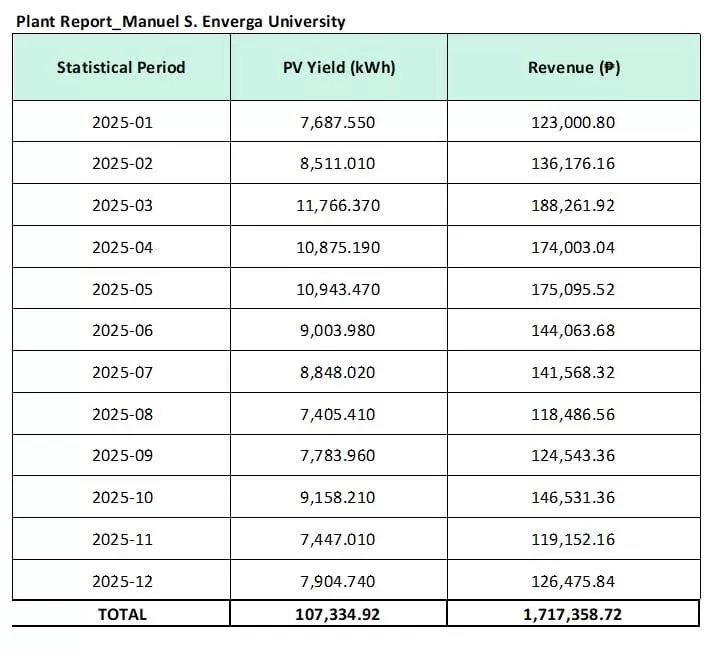
Based on the University's solar PV monitoring records, the CET Building system generated 107,334.92 kilowatt-hours (kWh) of renewable electricity from January to December 2025.
The system also recorded a corresponding electricity value of ₱1,717,358.72, demonstrating the financial value associated with the University's renewable energy generation.
The annual monitoring figures provide measurable evidence of MSEUF's continued utilization of renewable energy as an operational measure intended to reduce electricity-related carbon dioxide emissions.
Rather than relying solely on sustainability commitments, the University documented its renewable energy contribution using actual electricity generation records.
 |
Monitoring estimated carbon dioxide avoidance and environmental performance
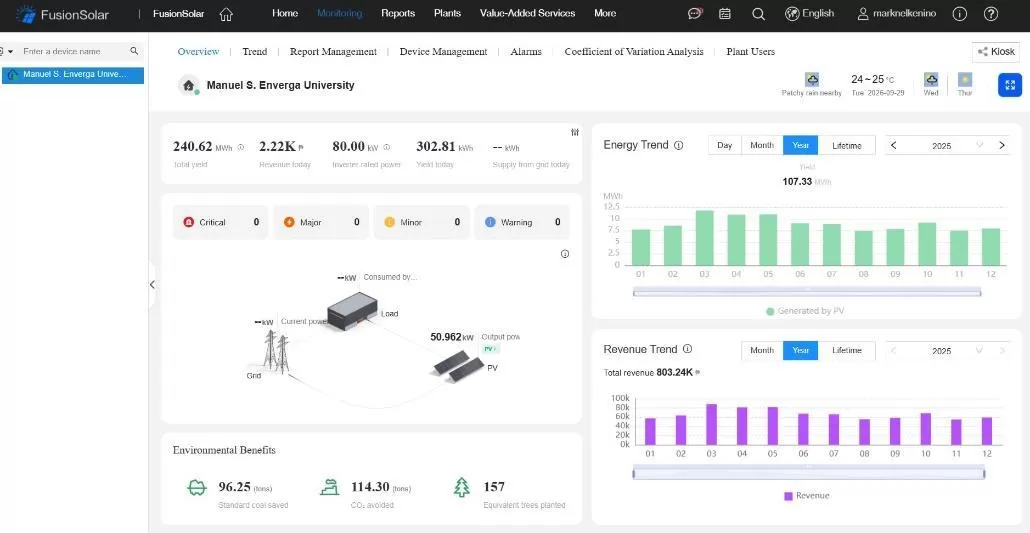
MSEUF supported its carbon reduction efforts through continuous monitoring of the CET Building's solar PV system using a digital monitoring dashboard.
The dashboard documented electricity generation and reported environmental indicators, including estimated carbon dioxide avoidance and equivalent trees planted.
These indicators provided information on the potential environmental benefits associated with renewable electricity generation.
The University's 2025 solar generation report and monitoring dashboard served as documented records for assessing the contribution of renewable energy utilization to its emissions reduction efforts.
By tracking actual electricity production and reported environmental indicators, MSEUF strengthened its capacity to assess renewable energy performance and document the environmental contribution of its solar PV operations.
These records provide a measurable component of the University's energy-related carbon management activities, although the reported carbon dioxide avoidance estimates remain dependent on the calculation methodology used by the monitoring system.
 |
Expanding institutional carbon reduction measures through sustainable investment
Building on the University's renewable energy initiatives, MSEUF Management approved plans in 2025 to expand solar photovoltaic installations to six additional campus buildings.
The approved expansion covered the College of Criminal Justice and Criminology (CCJC), College of International Hospitality and Tourism Management (CIHTM), Basic Education Department, Arts and Education, Library, and College of Nursing and Allied Health Sciences buildings.
University Management also approved a budget for the CCJC Building's solar PV installation, with implementation scheduled for the first part of 2026.
These management decisions demonstrated MSEUF's intention to expand renewable electricity generation beyond the existing CET Building system.
The approved investments formed part of the University's continuing approach to reducing reliance on grid-supplied electricity and the environmental impact of campus operations.
By linking the monitoring of existing renewable energy infrastructure with investment decisions for additional installations, MSEUF demonstrated how its carbon reduction initiatives informed subsequent institutional planning.
Reviewing implementation and supporting continuous improvement
On Dec. 9, 2025, MSEUF conducted its Sustainability Policy Year-End Review in conjunction with a Technical Working Group Committee Meeting at the Institute of Graduate Studies and Research Conference Room.
The review documented the University's sustainability accomplishments and continuing priorities, including renewable energy generation, carbon reduction and emissions reduction initiatives.
It provided an institutional opportunity to evaluate implemented measures, assess progress against sustainability priorities and guide subsequent action plans.
The University's documented 2025 initiatives illustrate an interconnected approach to managing energy-related carbon emissions: renewable electricity generation provided an operational reduction measure, monitoring records documented performance, management approvals supported continued investment, and institutional review informed future priorities.
Through these activities, MSEUF continued strengthening its efforts toward responsible energy management and reduced dependence on conventional electricity sources.
Continuing MSEUF's carbon management and emissions reduction efforts
MSEUF's 2025 initiatives demonstrated a continuing institutional approach to reducing energy-related carbon dioxide emissions through renewable energy implementation, performance monitoring, management-approved expansion and sustainability review.
The University documented 107,334.92 kWh of solar electricity generation, monitored estimated environmental benefits, approved additional renewable energy investments and reviewed sustainability accomplishments to guide further improvements.
Together, these measures support MSEUF's efforts to manage the environmental impact of campus energy use and advance SDG 7: Affordable and Clean Energy, particularly Indicator 7.2.3 on carbon reduction and emission reduction processes, while contributing to SDG 13: Climate Action.
The initiatives also reflect the University's commitment to Mindfulness, Service and Excellence through responsible resource management and continuous institutional improvement.