

Manuel S. Enverga University Foundation (MSEUF) strengthened its commitment to meaningful education on the United Nations Sustainable Development Goals (SDGs) in September 2025 by joining the global SDG Accord, building on its documented efforts to incorporate sustainability concepts into academic programs across the University.
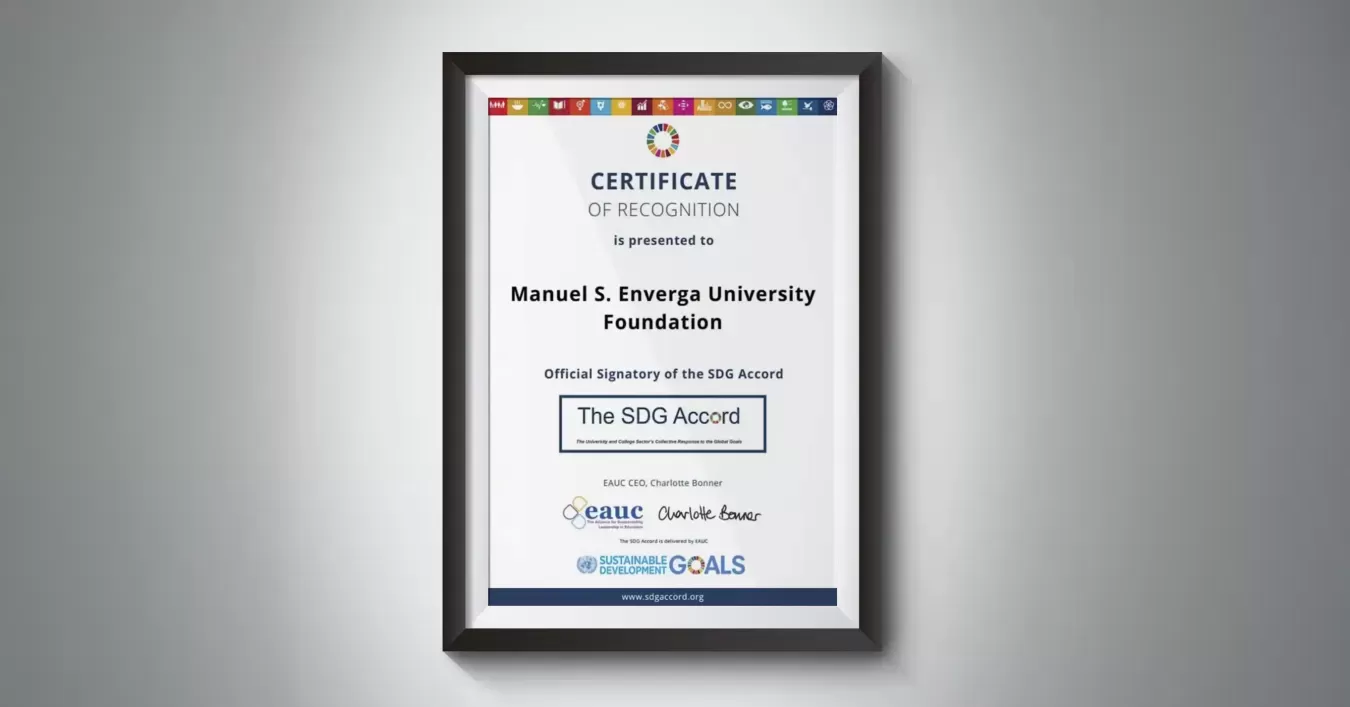
The Environmental Association for Universities and Colleges (EAUC), the secretariat of the SDG Accord, issued a Certificate of Recognition acknowledging MSEUF's participation in the international initiative.
Through the Accord, MSEUF committed to embedding the SDGs into teaching, research, operations and community engagement. The University also identified curriculum integration, faculty engagement, SDG-linked assessments and public sustainability reporting among its institutional priorities.
 |
Sustainability education across academic programs
MSEUF's sustainability commitment builds on its previously documented efforts to incorporate environmental responsibility, social development, ethical governance, resource conservation and sustainable practices into academic instruction.
In its sustainability education inventory published in October 2023, the University identified subjects across different undergraduate and graduate programs that address sustainability-related concepts. These courses connect disciplinary learning with environmental, economic and social issues, helping students understand how their fields can contribute to sustainable development.
The following selected courses illustrate sustainability-related learning opportunities across the University's academic disciplines.
| Academic program | Course title | Sustainability-related learning |
|---|---|---|
| BS Environmental Science | Environmental Impact Assessment | Environmental consequences of development projects and sustainable alternatives |
| BS Biology | General Ecology | Biodiversity, ecosystem conservation and human impacts on natural resources |
| BS Economics | Resource Economics/Environmental Comparative Economic Systems | Sustainable natural resource use and environmental economic policies |
| BS Public Administration | Governance and Development | Governance strategies for economic, social and environmental sustainability |
| BS Psychology | Social Psychology | Social cooperation and behavior supporting sustainable communities |
| BS Business Administration | Good Governance and Social Responsibility | Responsible waste disposal and environmentally friendly production materials |
| BS Computer Science | CS Thesis 1 | Research and technology solutions addressing environmental challenges |
| BS Information Technology | Capstone Project 1 | Technology-based solutions for agriculture and resource management |
| BS Architecture | Architectural Design 4 – Space Planning 1 | Energy conservation and responsible space management |
| BS Civil Engineering | CE Project | Integration of sustainability principles into engineering projects |
| BS Electronics and Communication Engineering | ECE Design Project | Renewable energy, sustainable technologies and green building applications |
| BS Electrical Engineering | Environmental Science and Engineering | Environmental protection and sustainable engineering solutions |
| BS Computer Engineering | BSCpE Project | Engineering projects integrating SDG-related principles |
| BS Geodetic Engineering | Land Use Planning & Development (Lec/Lab) | Responsible land-use planning and resource management |
| Bachelor of Elementary Education | The Contemporary World | Climate change, global inequality and sustainable development |
| BS Marine Transportation | Protection of Marine Environment | Marine conservation and maritime pollution prevention |
| BS Marine Engineering | Protection of Marine Environment | Waste management and marine pollution prevention |
| BS Nursing | Community Health Nursing 1 & 2 | Community health, public health sustainability and resource management |
| BS Medical Technology | Principles of Medical Laboratory Science 1 & 2 | Sustainable laboratory practices, safety and waste management |
| BS Criminology | Introduction to Criminal Justice System | Social sustainability, justice and strong institutions |
| BS Tourism Management | Sustainable Tourism | Environmental conservation and responsible tourism practices |
| BS Hospitality Management | Culinary Nutrition | Sustainable food sourcing, food systems and waste reduction |
| Master in Public Administration | Public Policy | Environmental, social and economic sustainability in policymaking |
| Master in Management, specializing in Engineering Management | Project Development & Management | Environmental and social considerations in project planning |
| Juris Doctor | Natural Resources and Environmental Law | Environmental protection and responsible management of natural resources |
The inventory demonstrates the University's interdisciplinary approach to sustainability education. Environmental science and engineering courses address ecological protection and resource conservation, while business, economics and public administration subjects examine responsible governance and sustainable development.
Health sciences, education, maritime studies and tourism programs also connect sustainability with community well-being, professional responsibility and environmental stewardship.
These examples illustrate how sustainability-related knowledge can be applied in different professions, consistent with MSEUF's educational philosophy of learning by doing, transformative learning and outcomes-oriented education.
Strengthening meaningful education for the SDGs
MSEUF recognizes that sustainability education extends beyond environmental awareness. It involves developing students' understanding of economic responsibility, social equity, ethical leadership and the long-term effects of professional and community decisions.
Through sustainability-related academic subjects, students encounter issues that connect their disciplines with the SDGs. These learning opportunities provide a foundation for applying academic knowledge to challenges affecting local communities and the wider world.
The University's participation in the SDG Accord strengthens this direction by establishing a formal commitment to curriculum integration and encouraging faculty members to incorporate SDG-related learning assessments into academic instruction.
Advancing education through international cooperation and accountability
As a signatory of the SDG Accord, MSEUF committed to strengthening institutional accountability by documenting sustainability-related outcomes, identifying improvement targets and sharing progress with other higher education institutions.
The Accord also encourages participating institutions to align campus practices with the SDGs and contribute to international knowledge-sharing initiatives.
By connecting its documented sustainability education initiatives with an international commitment, MSEUF reinforces its responsibility to prepare graduates who understand sustainable development and can contribute to addressing environmental, social and economic challenges.
MSEUF continues to advance its vision of becoming a globally competitive university through excellence in instruction, research and community service. Its commitment to sustainability education supports the development of knowledgeable, professionally competent and socially responsible graduates who can contribute to national development and global sustainability goals.